Can You Wear a Smart Ring in an MRI? (Safety Answer)
No - remove your smart ring before an MRI. Why the scanner can damage ring electronics, what X-rays and airports do differently, and scan-day tips.
This question matters because smart rings are designed never to come off - people shower, swim and sleep in them, so an MRI appointment is one of the few genuine removal moments. The answer is an unambiguous no, but the reasons are worth two minutes, because they also explain what the scan would otherwise do to your £300 ring.
Why can't a smart ring go in an MRI?
Three separate problems
1. The scanner versus the ring. An MRI's magnetic field is measured in teslas - tens of thousands of times Earth's field - and it flips rapidly during imaging. Those changing fields induce currents in any conductive loop, and a metal ring wrapped in coils, a battery and a circuit board is exactly that. The result can be a corrupted sensor, a damaged battery or a dead ring. The FDA's MRI benefits-and-risks page warns that the scanner can make electrically active devices malfunction, and scanner damage is not something to test against your ring's warranty.
2. The ring versus your scan. Metal near the imaging area creates artefacts - distorted, signal-voided patches that can make images unreadable. Even for a head scan, radiographers remove hand jewellery as routine because artefact behaviour is not worth gambling a rescan on.
3. The ring versus your finger. Induced currents heat metal. A solid band that cannot be quickly slipped off a swelling finger is precisely what MRI safety screening exists to catch - the FDA calls careful screening of people and objects entering the scanner room critical, and lists burns from radiofrequency heating as the most commonly reported patient problem. Titanium being only weakly magnetic does not exempt it - heating and induction affect conductive metals regardless of whether they are ferromagnetic.
What about X-rays, CT scans and airport security?
Graduated answers
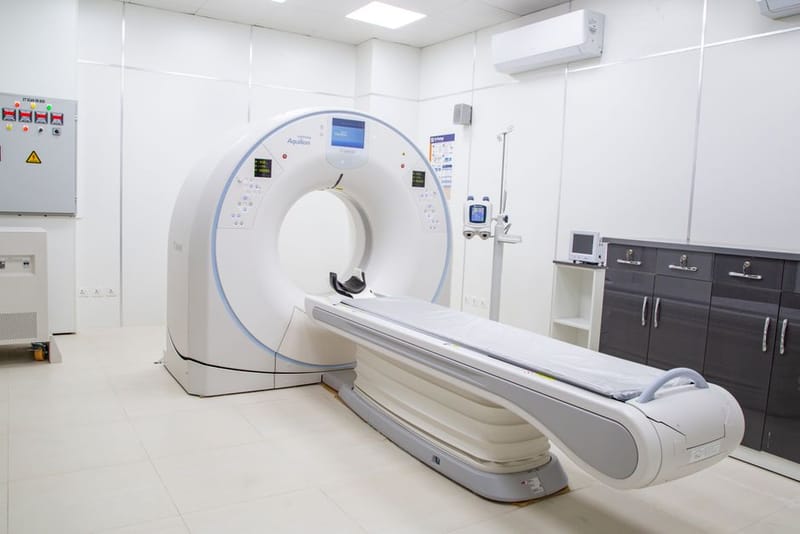
X-ray and CT: no magnetic risk to you or the ring. The reason to take it off is the image: the metal band is radio-opaque and will shadow whatever sits behind it, so for a hand, wrist or arm X-ray the radiographer will ask for it anyway. For a scan elsewhere on the body it matters less - follow the radiographer's instruction on the day. Removal takes two seconds.
Airport security: completely fine. Metal detectors and body scanners use fields and millimetre waves that are orders of magnitude gentler than an MRI. Most wearers walk through without triggering anything; at worst you get a manual check. Oura's own Product Safety & Use page says you can wear the Oura Ring through airport X-ray machines, metal detectors and scanners - our smart ring travel and airport security guide covers the rest of the trip.
Everyday magnets (induction hobs, magnetic phone mounts, speaker magnets) are harmless to a smart ring at normal distances.
What do smart ring makers say about MRI?
Less than you might expect
Less than the question deserves. Oura (the Finnish maker of the best-selling smart ring) covers charging, water, heat and airport scanners on its Product Safety & Use page, but that page says nothing about MRI or CT. We have not found a manufacturer page that sets out an MRI rule for its ring, so this guide does not lean on one.
That gap does not change the answer, because the decision is not the manufacturer's to make. The hospital's MRI safety screening decides what enters the scanner room, and the NHS guidance on preparing for an MRI scan asks patients not to wear anything with metal in it, such as jewellery, hair clips or hearing aids. A smart ring is jewellery with a battery inside. If you want a written answer for your own model, ask the maker's support team before the appointment - but plan to take it off regardless.
Practical tips for scan day
Protect the data streak too
Take the ring off at home and leave it on its charger - an MRI appointment is a convenient top-up window, and a charging ring is a ring you cannot forget in a hospital locker tray. If you track sleep streaks or recovery scores, a few hours' gap in daytime data barely registers in any ring's scoring model. And mention every implant or wearable at the safety screening anyway - that conversation is the system working, not an inconvenience.