Oura Ring 4 Review (2026): Is It Worth It With a Membership?
The Oura Ring 4 is still the most refined smart ring you can buy in 2026 - but the subscription pushes the real first-year cost close to £400 in the UK ($415 in the US). Worth it if you care about sleep, HRV trends and women's-health metrics and you're comfortable with an ongoing bill. If you'd resent the membership, Ultrahuman Ring Air and RingConn Gen 2 are credible no-subscription alternatives. Score: 4.3 / 5.
Strengths
- Sleep-stage and HRV algorithms repeatedly validated as the closest to polysomnography in independent testing
- Titanium build with recessed PPG sensors holds up to daily wear with minimal scuffing
- Genuinely useful women's-health, metabolic and Resilience metrics not matched elsewhere yet
Watch outs
- Oura Membership at £5.99 / $5.99 per month is non-negotiable for the bulk of features - adds ~£66 to year one in the UK
- No continuous SpO2 or always-on heart rate; the ring is not a fitness primary
- Higher finishes (Stealth, Gold) charge £50–£200 more for cosmetic differences only
- Material Titanium with PVD coating
- Weight 3.3–5.2g depending on size
- Sizes US 4 to US 15 (range expanded in 2026)
- Finishes Heritage, Stealth, Gold, Rose Gold, Brushed Silver, Black
- Sensors PPG (green/red/IR), SpO2, NTC temperature, accelerometer
- Water resistance 100m / 10 ATM
We may earn a commission if you buy through this link - it never changes the price you pay or our editorial verdict.
As an Amazon Associate I earn from qualifying purchases.
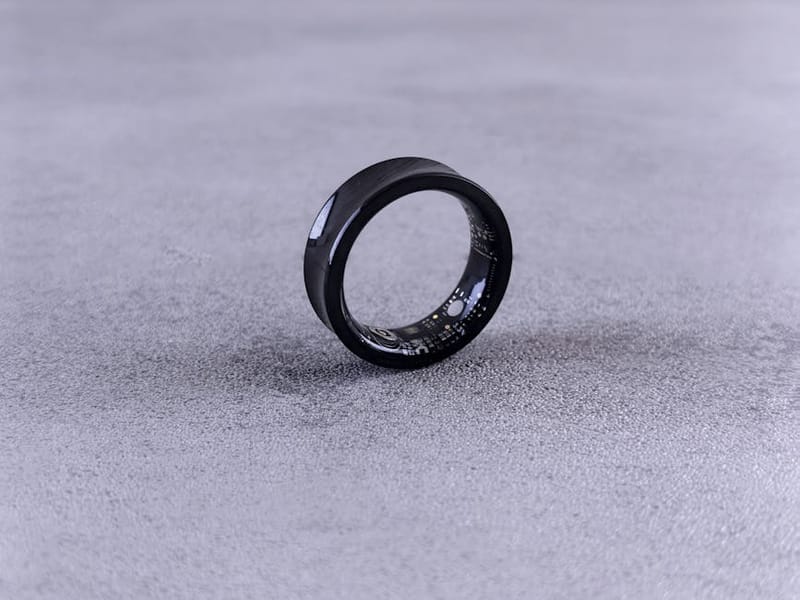
The Oura Ring 4 is the category leader in smart rings - a £349 titanium ring with recessed PPG sensors, four-to-seven day battery, and the most refined sleep-and-HRV algorithms on the market. It is also the only mainstream smart ring that still gates the bulk of its features behind a monthly subscription. This Oura Ring 4 review walks through what you get for the money, where the accuracy data actually puts it, and whether the total first-year cost is worth paying in 2026.
What do you actually get for £349?
The Oura Ring 4 is a 3.3-to-5.2-gram titanium ring (weight scales with size) with the sensor array set into the inner face. The big mechanical change versus the Gen 3 is that the bumps are gone: the PPG sensors are recessed flush into the ring's inner surface, which owners say makes the ring sit more comfortably on the finger, with fewer raised edges to catch on fabric or bash against door frames. Most users in long-term threads on Oura's community forum report the titanium finish holding up well for two to three years before noticeable scuffs, which is roughly the usable lifespan of the battery anyway.
Inside the ring you get the full sensor stack - green, red and infrared photoplethysmography (PPG) for heart rate, heart-rate variability and overnight blood-oxygen estimation; an NTC thermistor for continuous skin-temperature variance; and a 3D accelerometer for movement and sleep-stage detection. The ring is rated to 100m water resistance (10 ATM), so swimming and showering are fine; sauna and hot-tub use sit at the edge of the spec and Oura advises caution.
Sizing is a faff but a worthwhile one. Oura ships a free sizing kit before the real ring is dispatched - you wear plastic dummy rings for 24 hours on the finger you intend to use and pick the size that's comfortable when warm. Getting this right matters more than people think: PPG sensors need consistent skin contact, so a too-loose ring will produce noisy data.
How accurate is the Oura Ring 4's sleep tracking?
This is the most important section of any smart ring review, because sleep tracking is the feature most buyers actually care about. The headline finding from independent testing: the Oura Ring 4 is still the closest consumer wearable to polysomnography (PSG) - the lab-grade overnight test that EEG sleep labs use as ground truth.
Independent reviewer The Quantified Scientist (Rob ter Horst) has run PSG-validated tests against every major smart ring and watch on the market, and his published agreement metrics for Oura Gen 4 sit around 60–65% epoch-by-epoch agreement on sleep-stage classification (light / deep / REM / wake). That sounds modest in absolute terms, but it is the highest score any consumer wearable has hit. For comparison, the Apple Watch typically scores 50–55%, the Whoop 4.0 around 55–60% and Ultrahuman Ring Air around 55%. Heart-rate agreement is even better - within 1–3 beats per minute of medical reference equipment overnight.
What this means in practice: total sleep time and overall wake-after-sleep-onset numbers from Oura are reliable. The stage-by-stage breakdown (specifically the deep/REM split) carries more uncertainty than the in-app graphs suggest. Read the daily totals; treat individual stage minutes as directional rather than precise. The HRV trend is more useful than any single night's stage breakdown anyway.
How do HRV, readiness and the compounding metrics work?
HRV (heart-rate variability) is the metric that most consistently rewards long-term smart ring ownership. Oura reports nightly HRV using RMSSD, the standard measure used by sports-medicine researchers, sampled from your most restful sleep window each night. The absolute number depends on age, fitness and recovery state, but the trend over weeks and months tells you whether your nervous-system load is climbing, holding steady or recovering.
This is where the membership starts paying back. Oura's Readiness score combines HRV, resting heart rate, body-temperature variance and sleep debt into a single 0–100 number that is broadly directional rather than precise - but it correlates well with how you feel after a hard week, jet lag, or illness onset. Several users report the temperature-variance feature flagging an oncoming cold a day or two before they felt symptoms; that is not medical detection, but it is a useful real-world signal.
For women, Oura's cycle-tracking and predictive period features remain the most sophisticated in the category - built on continuous temperature variance rather than self-reported calendar entries. Importantly: none of these features are MHRA-cleared or FDA-cleared for clinical use. They are consumer wellness signals, not medical devices. Do not use Oura for contraceptive decisions, cycle-related medical diagnosis, or sleep-disorder diagnosis. If you suspect a clinical issue, see a doctor.
What's the battery life and day-to-day experience?
Oura advertises up to 8 days of battery; the realistic figure is 4–7 days, depending mostly on how aggressively you use continuous heart-rate features and how warm your skin runs (PPG sensors work harder when contact is variable). The proprietary charging puck takes a ring from empty to full in about 80 minutes, which makes a low-friction routine: pop the ring on the puck while you shower or eat breakfast, put it back on, no missed data window.
Day-to-day, the Oura is unobtrusive - that's the form factor's job. The downside of having no screen is that you have to open the app to see anything. The morning ritual of checking the Sleep and Readiness screens is genuinely pleasant, but the ring contributes nothing live during the day beyond passively logging data.
How good is the app, and is there a lock-in problem?
The Oura app is the best-designed wearable app on the market - clean information hierarchy, calm colour palette, useful weekly and monthly views, and a steady drip of new features (Resilience, Cardiovascular Age, daytime stress) that justify the subscription for committed users. Apple Health and Google Health Connect integrations are first-class, so your daily totals flow into the broader picture.
The catch is data portability. Oura provides a member data export, but it ships as a flat CSV that is genuinely awkward to reuse in third-party tooling. If you switch to a different ring in three years, expect your historical context to effectively reset - the only ring whose long-term archive will live with you forever is the one whose subscription you're still paying. That is uncomfortable to think about for a wellness device pitched on long-term trends.
What's changed since launch? A mid-2026 update
Six months on: battery, sizes, subscription and the competition
Battery in real use. Six months of real-world reports settle the Ring 4's battery at five to seven days rather than the headline eight, broadly as expected. Owners see a gentle decline over time: lithium-polymer cells hold around 80 percent of capacity after 300 to 500 charge cycles, so most people lose roughly a day of runtime somewhere around the 18-to-24-month mark. That is normal wear, not a fault, but worth factoring into a multi-year purchase.
A wider size range. Oura expanded the Ring 4 to US sizes 4 to 15, four more than the Gen 3, so the fit is now better at both the smaller and larger ends of the scale. Order the free sizing kit before you buy, because ring fit makes a real difference to overnight accuracy.
The subscription is unchanged. Membership still costs £5.99 a month or £69.99 a year, with the first month free, and the full readiness, sleep-staging and trend analysis still sit behind it. That remains the Ring 4's single biggest catch and the main reason owners move to a no-subscription rival.
The competition has sharpened. The no-subscription pressure has only grown. The Samsung Galaxy Ring (up to seven days, no fee, FDA-cleared cycle algorithm), the Ultrahuman Ring Pro and our value pick the RingConn Gen 3 all deliver the core metrics with nothing monthly to pay. Oura still leads on app polish and sleep-stage accuracy, but the gap is narrower than it was at launch.
Where does the Oura Ring 4 fall short?
Three honest weaknesses, separate from the subscription question.
First, it is not a fitness ring. Workout detection is approximate and there is no live heart-rate broadcast to a watch or bike head unit. If you want a wearable that drives your training session in real time, an Apple Watch, Garmin or Whoop is a better fit; the Oura is the recovery half of that pairing, not a replacement.
Second, the SpO2 reading is a sleep-window spot-check rather than a continuous overnight curve. For most users this is fine; for anyone specifically tracking suspected sleep-disordered breathing, the data density will frustrate.
Third, the premium finishes carry a significant cosmetic-only markup. Stealth and Gold start at £399 (and Gold Rose Gold variants climb higher); the underlying sensor stack and software are identical to the Heritage model. If the brushed-titanium aesthetic suits you, the £349 Heritage is the rational pick.
Which alternatives should you consider?
Three credible no-subscription rivals are worth knowing about before you commit. RingConn Gen 3 is our value pick: subscription-free, the longest battery in the category and now with a vibration motor and vascular-trend tracking. Ultrahuman Ring Pro is the metabolic-focused option, also subscription-free. The Samsung Galaxy Ring is the pick for Samsung-phone owners who want cycle tracking with no monthly fee. All three trade some of Oura's app polish for a lower total cost of ownership.
Who should buy the Oura Ring 4?
Buy the Oura Ring 4 if: you take sleep and recovery seriously, you'll use the HRV-and-temperature trends across months and seasons, you value the women's-health features, and the monthly subscription is a price you'd happily pay for a service you use daily. For that profile, this is still the best smart ring you can buy in 2026.
Skip the Oura Ring 4 if: the subscription feels like a recurring tax on data you already own, you want a fitness-primary wearable, or your total wellness-tech budget is closer to £200 than £400. The Ultrahuman Ring Air and RingConn Gen 2 both offer 80–85% of the experience without the membership bill.
Frequently asked questions
Is Oura Ring 4 worth it without the membership?
What is the total first-year cost of the Oura Ring 4 in the UK?
How does Oura Ring 4 compare to the Gen 3?
Is the Oura Ring 4 a medical device?
Can I export my Oura data?
Does the Oura Ring 4 work with Apple Watch or Garmin?
Check current Oura Ring 4 pricing
Oura sells direct in the UK and US; the Heritage finish lists at £349 / $349 plus the required membership, but clearance discounts since the Ring 5 launch mean street prices often sit well below list - verify current pricing before you commit.