Ultrahuman Ring Air Review 2026: Best No-Subscription Pick
The Ultrahuman Ring Air is the strongest no-subscription smart ring you can buy in 2026 - lighter than Oura, equally water-resistant, and at £329 with every feature included it undercuts the Oura Ring 4's real first-year cost by ~£90. Accuracy lags Oura by a small but measurable margin in independent sleep and HRV comparisons, and the active Oura-versus-Ultrahuman patent litigation remains an unresolved buying consideration. Recommended for buyers who would resent an Oura Membership and value one-time-cost ownership over the most polished app experience. Score: 4.0 / 5.
Strengths
- No subscription - every current Ultrahuman feature, including sleep, HRV, temperature and recovery, is included with the £329 hardware purchase
- Materially lighter than Oura at 2.4 – 3.6 g, which most reviewers cite as the single biggest comfort-during-sleep advantage
- 10 ATM water resistance covers swimming, showering and water sports without the cautious-wear advisories some rivals attach
Watch outs
- Sleep-stage and HRV accuracy track Oura closely in independent reviewer comparisons but remain a measurable step behind it
- The Ultrahuman app is denser, more metric-heavy and less polished than Oura's - a steeper learning curve for first-time wearable users
- Battery life is realistic 4 – 6 days rather than the marketing-page 6+, and slightly behind Oura's 4 – 7 day real-world range
- Form factor Smart ring, continuous wear
- Material Tungsten carbide shell, hypoallergenic inner
- Weight 2.4 – 3.6 g
- Sizes US 5 – 14 (free sizing kit)
- Finishes Aster Black, Matte Grey, Bionic Gold, Space Silver, Raw Titanium
- Sensors PPG (red + green), skin temperature, IR, 6-axis accelerometer
We may earn a commission if you buy through this link - it never changes the price you pay or our editorial verdict.
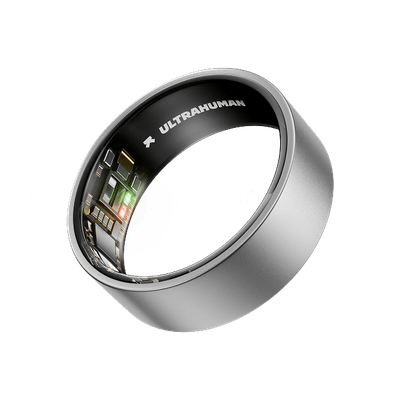
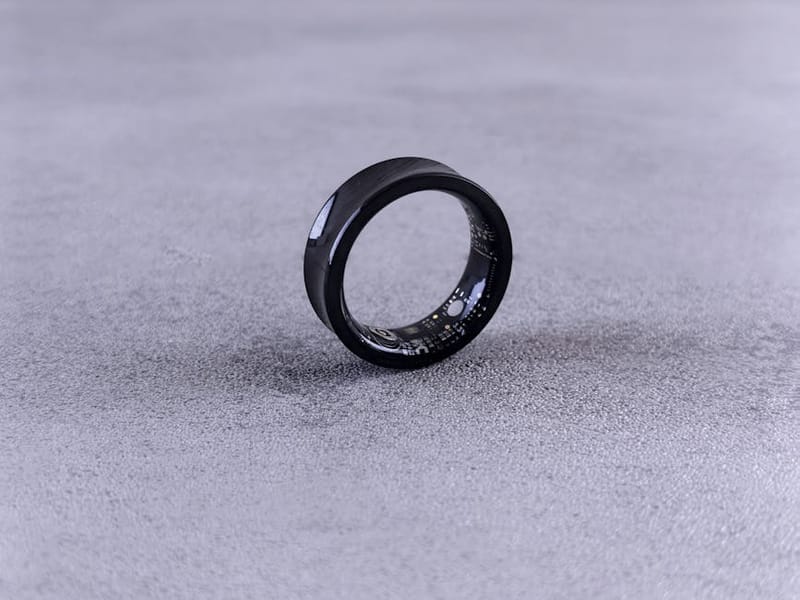
The Ultrahuman Ring Air is the most direct challenger to the Oura Ring 4 - and the single piece of friction it removes is the one Oura has refused to touch: the monthly subscription. At £329 in the UK and $349 in the US, the Ring Air ships with the full feature set unlocked. Sleep stages, HRV, recovery score, skin temperature, women's cycle insights and the PowerPlugs marketplace are all included with the hardware purchase. There is no ongoing bill.
That changes the buying equation. The Oura Ring 4 starts at £349 but the £5.99/month membership pushes the real first-year cost roughly £72 higher in the first year. Ultrahuman's £329 entry price puts the Ring Air at around £90 less for year one and roughly £380 less over five years of ownership.
The remaining question is whether the Ring Air is good enough on the metrics that matter to justify the saving - and that is more nuanced than the price gap suggests.
What do you get for the money?
The Ring Air is a tungsten-carbide-shelled smart ring weighing 2.4 to 3.6 grams depending on size and finish - meaningfully lighter than the Oura Ring 4 (3.3 – 5.2 g) and a noticeable advantage during sleep, the metric most reviewers single out. It carries the standard wearable sensor stack: PPG with red and green LEDs, skin temperature, infrared, and a 6-axis accelerometer. Water resistance is 10 ATM (roughly 100 metres), covering swimming and showering without caveat.
Battery life is advertised at up to six days. The realistic figure, consistent across published independent reviews, is four to six days under typical PPG-on, temperature-on, accelerometer-on use. A small puck-style charger ships in the box; full charge takes about two hours.
How accurately does the Ring Air track sleep vs Oura?
Sleep is the metric most smart-ring buyers prioritise, and it is the area where Oura's lead is most defensible. The Ring Air's sleep-stage breakdown (wake, light, deep, REM) is competent but consistently positioned in the second tier of independent comparison testing - closer to Apple Watch and Fitbit than to Oura's class-leading algorithms.
The practical implication for buyers: nightly directional accuracy (did I sleep well, did I get enough deep sleep) is reliable on the Ring Air. Absolute minute-by-minute stage accuracy against polysomnography is where Oura still pulls meaningfully ahead. If you are tracking sleep for casual recovery awareness, the gap is unlikely to matter day to day. If you are using the data to drive medical, athletic-performance or research decisions, it does.
Resting heart rate, heart-rate variability and skin-temperature trending - the three metrics that compound across nights - all track within an acceptable margin of Oura on the Ring Air, with the same expected divergence between any two PPG wearables.
How does the HRV and recovery metrics ecosystem work?
The Ring Air's recovery score (branded Movement and Recovery in the Ultrahuman app) pulls from HRV, resting heart rate, sleep quality and temperature deviation. The output format is broadly comparable to Oura Readiness or Whoop Recovery - a 0 – 100 score with traffic-light banding and the day's primary contributing factor.
Ultrahuman's editorial slant is more aggressively performance-and-metabolic-focused than Oura's. The app emphasises caffeine and glucose-spike correlations through PowerPlugs (paid-but-not-subscription add-ons that connect external data sources), and surfaces stimulant-and-recovery interactions more prominently. Whether that framing helps depends entirely on what you are using the ring for. For sleep and general well-being, Oura's gentler, narrative-led app is the more accessible experience. For training-and-metabolic optimisation, the Ring Air's app has a closer fit.
What's the battery and day-to-day wear experience?
Realistic battery life is four to six days with the standard sensor profile active. Heavy use of the new continuous SpO2 and AFib monitoring add-ons drops that toward four days; lighter use stretches it nearer to six. A two-hour charge from empty is on par with the category. The charging puck is small enough to live in a travel bag without ceremony.
The 2.4 – 3.6 g weight is the headline daily-wear advantage. Reviewers and users repeatedly note the Ring Air is one of the few smart rings that genuinely disappears at night - a comfort threshold that matters more than spec-sheet differences for sleep tracking, because the wearable that you actually keep wearing produces the better dataset.
How good is the app and how portable is your data?
The Ultrahuman app is dense. The default home screen surfaces five to seven metrics in a single scroll - Movement Index, Recovery, Sleep Index, daily phases, temperature trend, and any active PowerPlugs. That density is the source of both common compliments (power users get more at a glance) and common complaints (newcomers find the early-week experience overwhelming).
Data export sits in roughly the same place as Oura's. CSV export of the underlying daily metrics is supported, but the historical record is effectively tied to the Ultrahuman app. Buyers who care about portable, third-party-friendly health data should treat this as the category-wide limitation it is rather than an Ultrahuman-specific failing.
Where does the Ring Air fall short?
Three honest weaknesses, separate from the legal context above. First, sleep-stage accuracy remains a small but measurable step behind Oura - fine for casual use, less so for research-grade requirements. Second, the app's information density is a learning curve and reduces the chance a first-time wearable buyer sticks with it long enough to derive the trend value the ring is built for. Third, the premium finishes (Bionic Gold, Space Silver) attract the same £100 – £200 cosmetic markup as Oura's higher tiers - the no-subscription advantage narrows considerably at the top of the finish ladder.
Which alternatives should you consider?
Two clear alternatives sit either side of the Ring Air. The Oura Ring 4 remains the category benchmark for accuracy and app polish, at a real first-year cost of around £421 once the membership is included - buy it if the subscription is acceptable and you want the most refined experience. The RingConn Gen 2 is the value-led no-subscription alternative below the Ring Air, with broadly comparable core metrics, lower battery longevity, and a meaningfully cheaper entry price. If you want an even cheaper subscription-free pick with a heart-health focus, the Amazfit Helio Ring sits below the Gen 2 on price and is the budget end of the no-subscription tier.
Who should buy the Ultrahuman Ring Air?
Buy the Ultrahuman Ring Air if: you want a full-featured smart ring without a recurring subscription, you care about sleep-tracking comfort and the lighter ring matters to you, and you are comfortable with the unresolved Oura patent litigation as a buying caveat. The £329 entry price plus zero ongoing cost makes it the strongest no-subscription pick in the 2026 flagship tier.
Skip the Ring Air if: you want the most accurate sleep-stage and HRV data money can buy (choose Oura), you prefer a gentler, more narrative-led app experience (choose Oura), or you specifically need the cheapest no-subscription ring on the market and are willing to trade battery life and feature breadth for it (consider RingConn Gen 2).
Frequently asked questions
Does the Ultrahuman Ring Air really have no subscription?
How does the Ring Air compare to the Oura Ring 4 on accuracy?
Is the Oura–Ultrahuman patent lawsuit a buying risk?
How long does the Ring Air's battery actually last?
Is the Ring Air a serious fitness tracker?
Check current Ultrahuman Ring Air pricing
Hardware-only price; no subscription required. Pricing and stock vary by finish and region.