Smart Ring vs CGM (2026): What Each Actually Measures
Smart rings cannot measure blood glucose. CGMs can. Here is what each device actually measures, MHRA and FDA status, and which one fits which goal.
Wearable health tracking has converged on two device formats that get confused for each other in marketing copy but measure entirely different physiology. This guide explains what each measures, what neither can measure, the regulatory framing under MHRA in the UK and FDA in the US, and which device makes sense for which user goal.
What does a smart ring actually measure?
Modern consumer smart rings (Oura Ring 4, Ultrahuman Ring Air, RingConn Gen 2, Samsung Galaxy Ring) share a near-identical sensor stack:
- Photoplethysmography (PPG) sensors - green, red, and infrared LEDs pulsing against the finger to detect blood volume changes. PPG produces heart rate, heart rate variability (HRV), blood oxygen (SpO2), and respiratory rate.
- Skin temperature sensors - thermistors against the palmar finger surface measuring skin temperature with ~0.1 degree resolution. Used to detect circadian rhythm shifts and (in some models) menstrual cycle phase.
- 3-axis accelerometer - movement and step count, and during sleep, posture detection.
That sensor stack is mature enough to produce reliable measurements of physiological signals in the cardiovascular, respiratory, and circadian domains. The output metrics depend on signal processing software rather than additional sensors - Oura's readiness score, Ultrahuman's metabolic score, and similar aggregate metrics are all derived from this same raw sensor input.
What the sensor stack cannot do: measure anything that requires direct contact with interstitial fluid, blood, or tissue beneath the skin. Glucose, electrolytes, hormones, lactate, ketones, and any chemical analyte are out of reach for current consumer PPG-based devices.
What does a CGM actually measure?
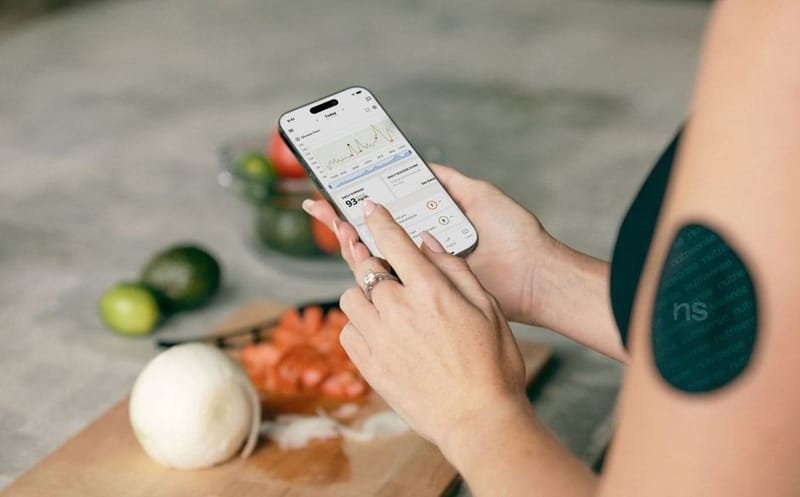
A continuous glucose monitor measures glucose concentration in the interstitial fluid between cells, not in the bloodstream directly. A small sensor filament (typically 5-6mm long) is inserted just under the skin via a single-use applicator and sits in the subcutaneous tissue for 7-14 days. The sensor uses glucose-oxidase enzymatic detection to convert glucose into an electrical signal proportional to its concentration.
Interstitial-fluid glucose lags blood glucose by approximately 5-15 minutes depending on whether glucose is rising or falling. Modern CGMs report glucose readings every 1-5 minutes, which is sufficient to track meal responses, exercise responses, and overnight stability.
The two consumer-relevant CGM platforms in 2026 are:
- Abbott FreeStyle Libre 3 - 14-day sensor wear, no fingerprick calibration required, smartphone reader, available on NHS prescription for Type 1 diabetes and selected Type 2 cases.
- Dexcom G7 - 10-day sensor wear, smartphone integration including Apple Watch and Android Wear, FDA-cleared for over-the-counter use as of 2024 (UK availability via private prescription).
Newer entrants like Levels Health and ZOE bundle FreeStyle Libre or Dexcom sensors with their own app + nutrition coaching, but the underlying hardware is the same. In 2026 there is no UK or US consumer CGM that measures glucose non-invasively.
How do smart rings and CGMs compare side by side?
| Smart Ring (Oura, Ultrahuman, RingConn, Samsung) | Continuous Glucose Monitor (FreeStyle Libre 3, Dexcom G7) | |
|---|---|---|
| Measures | Heart rate, HRV, SpO2, skin temperature, sleep stages, activity | Interstitial-fluid glucose concentration (1-5 min granularity) |
| Cannot measure | Blood glucose, electrolytes, hormones, lactate | Heart rate, HRV, sleep, activity (no built-in motion sensor) |
| How | Photoplethysmography (PPG) + thermistor + accelerometer | Subcutaneous glucose-oxidase enzymatic sensor |
| Wear pattern | 24/7, removed only for charging (~80 min every 5-7 days) | Single sensor lasts 10-14 days, then replaced |
| Regulatory status (UK) | Consumer device, not MHRA medical-device classified | MHRA Class IIb medical device, NHS available for Type 1 diabetes |
| Regulatory status (US) | Consumer device, not FDA-cleared (Oura SpO2 has limited FDA clearance for sleep apnea screening as a software-as-medical-device pathway) | FDA 510(k) cleared; Dexcom Stelo OTC since 2024 |
| Subscription required | Oura yes (£5.99/mo); Ultrahuman / RingConn / Samsung no | Sensor cost (~£50-£60 per 14-day sensor) is the running cost |
| Best for | Long-term cardiovascular trends, sleep optimisation, recovery readiness | Diabetes management, metabolic optimisation, meal-response insight |
Why can't smart rings measure blood glucose?
The short answer: the physics doesn't work yet. Glucose is a small, electrically neutral molecule whose optical signature is buried in a much louder background of water absorption and lipid absorption. Non-invasive optical detection of blood glucose requires distinguishing a glucose-specific signal at concentrations around 5 mmol/L from interference signals that are 100-1000x stronger.
Research into non-invasive optical glucose monitoring has been ongoing since the 1990s. Most candidate technologies (near-infrared spectroscopy, Raman spectroscopy, mid-infrared, photoacoustic, dielectric) can produce a glucose-correlated signal under laboratory conditions but fail to maintain calibration under real-world conditions - skin temperature changes, hydration changes, individual skin pigmentation, and pressure variation all degrade the signal-to-noise ratio enough to make standalone consumer products unreliable.
The FDA's February 2024 safety communication explicitly listed smart rings and smartwatches as devices that should not be used to measure blood glucose levels. The communication was a response to a wave of unbranded products marketed via social media as 'non-invasive glucose monitors' - typically pulse-oximetry rings rebadged with glucose-tracking software that produces fictitious readings unrelated to actual blood glucose.
Reliable, validated non-invasive glucose monitoring may eventually arrive (research from companies like Nemaura Medical's sugarBEAT and Movano Health is ongoing) but as of 2026 nothing on the consumer market measures actual blood glucose through a smart ring or smartwatch form factor.
Which device should you choose for which goal?
Type 1 or Type 2 diabetes management → CGM (with NHS pathway first)
If you have a diabetes diagnosis, a CGM is the appropriate clinical device. Speak to your GP about NHS-funded FreeStyle Libre 3 access - it has been routinely available for Type 1 diabetes since 2022 and is increasingly available for Type 2 on insulin or with frequent hypoglycaemia. Smart rings are not appropriate primary devices for diabetes management.
Metabolic health curiosity (non-diabetic) → CGM short-term, then smart ring long-term
A two-week FreeStyle Libre 3 sensor (~£60 private) gives meaningful insight into how specific foods, meal timing, and exercise affect your glucose response. This is the rationale behind ZOE and Levels Health. A smart ring is the better long-term choice for everyday metabolic and recovery tracking - the CGM is a 2-4 week diagnostic experiment, not a permanent companion.
Sleep quality + recovery optimisation → Smart ring
Smart rings are the right device for sleep tracking and HRV-based recovery scoring. The Oura Ring 4 and Ultrahuman Ring Air both produce reliable sleep-stage estimates and validated HRV trends. CGMs have no sleep or HRV data.
Athletic recovery + training load → Smart ring
Resting heart rate, HRV trends, and sleep quality are the foundational athletic recovery signals - a smart ring captures all three. CGMs are increasingly used by endurance athletes for fuel-strategy optimisation but they're a supplement to a smart ring or sports watch, not a replacement.
Both, if budget allows → Different roles, no conflict
The two devices measure orthogonal physiology and answer different questions. Many quantified-self users wear a smart ring 24/7 and run a 14-day CGM session every 6-12 months as a metabolic check-in. There is no device redundancy.
Frequently asked questions
Will smart rings ever measure blood glucose?
Are CGMs available on the NHS for non-diabetic users?
Can a smart ring detect early diabetes?
Is the Oura Ring FDA-cleared as a medical device?
What about smart rings with 'glucose tracking' marketing claims?
Can I use a CGM and a smart ring together?
Smart Ring Health Metrics Explained (HRV, Sleep, SpO2)
Smart Ring Sleep Apnea Tracking - What's Possible
Looking for a smart ring?
See our top picks across overall, fitness, sleep, and no-subscription categories.