Comparison · 2 picks
Oura Ring 4 vs Samsung Galaxy Ring: Which Wins in 2026?
Affiliate disclosure: we may earn a commission when you buy through links on this page, at no extra cost to you. Our verdicts are our own and are not influenced by compensation. As an Amazon Associate I earn from qualifying purchases.
Oura Ring 4 versus Samsung Galaxy Ring is the most consequential choice in the 2026 smart-ring market, because it isn't really about hardware - it's about which ecosystem you're willing to commit to. Oura works everywhere but charges a monthly fee. Samsung has no fee but mostly works on Galaxy phones. This page lays out the comparison the way an honest shop assistant would: who each ring is right for, and where the marketing glosses over the trade-offs.
At a glance
All 2 options side by side.
 |  | |
|---|---|---|
| Price | £349 | £399 |
| Best for | The right pick if you use an iPhone, or if you want the deepest sleep and HRV analysis the category currently offers. | The right pick if you already own a Galaxy phone and want a no-subscription ring that slots into the Samsung Health stack you're already using. |
| Review | Read review → | Read review → |
| Buy |
The picks in detail
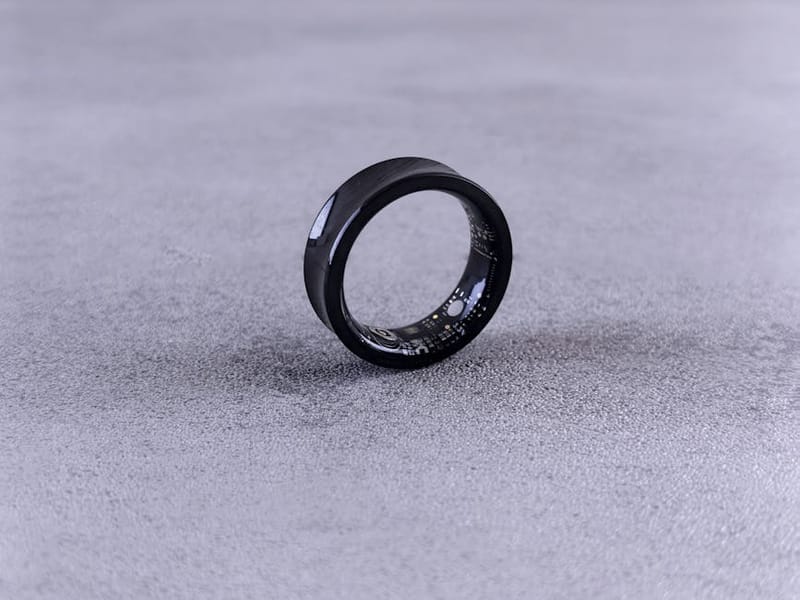
Oura Ring 4
Bottom line. The right pick if you use an iPhone, or if you want the deepest sleep and HRV analysis the category currently offers.
Pros
- The most refined sleep-stage and HRV algorithms in the category, repeatedly validated against polysomnography in independent testing
- Titanium build with recessed PPG sensors that survive daily wear - most users report two-to-three years before noticeable scuffs
- Four-to-seven day battery in normal use, with a small, fast-charging puck included in the box
- Multiple sizes (US 6–13) and three finishes (Heritage, Stealth, Gold/Rose Gold) for fit and aesthetics
- Genuinely innovative women's-health and metabolic-load metrics that competitors are still catching up on
Cons
- Oura Membership at £5.99/month is required to access the bulk of features - it adds £71.88 to the first-year cost
- No always-on heart rate or live workout heart-rate broadcast - fitness use is supplementary rather than primary
- No continuous SpO2 reading - overnight SpO2 is a spot-check during sleep, not 24/7
- Higher-priced finishes (Stealth, Gold) command a £50–£200 premium for cosmetic differences only
- Closed ecosystem - your historical data lives inside the Oura app and is difficult to export in a portable form
More buying options (1)
- Oura Check price View deal →
Samsung Galaxy Ring
Bottom line. The right pick if you already own a Galaxy phone and want a no-subscription ring that slots into the Samsung Health stack you're already using.
Pros
- No subscription - every feature on the device works for the lifetime of the ring with the included Samsung Health app
- Titanium build with a slightly concave outer profile that resists everyday scuffs visibly better than the flat-faced Oura 4
- Deep integration with Samsung Health and Galaxy phones - sleep, HRV, skin temperature, women's-cycle and AGEs Index all in one app you already use
- Wireless charging case included in the box (rare in the category - competitors ship a single puck) and rated up to 7 days battery life
- 10 ATM + IP68 water resistance so it can be worn in the shower and pool without removal
Cons
- Android-only in practice - there is no fully-supported iOS app, so iPhone owners should look elsewhere
- The most useful AI insights (My Vitality Score, advanced energy scoring) require a Galaxy phone running One UI 6.1+
- Sensor count is conservative - no SpO2, no ECG, no continuous skin-temperature stream, which means sleep-stage detail is less granular than Oura's stack
- Cycle and pregnancy tracking exists but is less feature-rich than the equivalent in Oura's app
- Sizes 5 and 6 carry visibly less battery than sizes 11–13, so small-finger users can expect closer to 5 days than 7
More buying options (1)
- Amazon Check price View deal →
What is the headline difference between these rings?
Every honest comparison of these two rings starts in the same place. They are price-competitive on the device (£349 vs £399 at UK launch) and broadly similar on titanium build, water resistance, and battery life. They differ on something more important: how you pay for the value.
Oura's model is the lower upfront price plus a recurring Oura Membership at £5.99 per month. Without the membership, the ring downgrades to basic step counting and a one-line readiness score - most of what you bought it for is locked behind the subscription. Across the typical three-year lifespan of a smart ring, that's roughly £215 in subscription costs on top of the £349 hardware, so the lifetime cost of an Oura Ring 4 is closer to £565 than £349.
Samsung's model is the higher upfront price with no recurring fee at all. The Galaxy Ring's £399 buys you the device, the charging case, and lifetime access to every feature Samsung Health surfaces from it. Across the same three-year window, that's £399 total - about £165 cheaper than the Oura over the device's life.
But there's a second, less obvious lock-in on the Samsung side: the ring is an Android product. Samsung Health technically exists on iOS, but the Galaxy Ring is not officially supported there, and the most interesting AI insights - the Energy Score, the AGEs Index, integrated sleep coaching - require a Galaxy phone running One UI 6.1 or later. If you have an iPhone or a non-Samsung Android, you are not the target buyer.
Which has better sensors and data quality?
On paper the sensor stacks look similar. Both rings carry PPG sensors for heart rate and HRV, a 3-axis accelerometer for movement and sleep posture, and a skin-temperature sensor for cycle tracking and illness detection. The Oura Ring 4 layers on more colour channels in the PPG (green, red, and infrared) and a continuous SpO2 spot-check during sleep - capabilities the Galaxy Ring doesn't match.
What matters more than the sensor count is the algorithm work behind it. Oura has been refining its sleep-staging model for nearly a decade and has commissioned multiple independent validation studies against polysomnography, the clinical gold standard. The Galaxy Ring's sleep algorithm is newer and inherits some maturity from Samsung's larger Galaxy Watch product, but the body of independent validation behind it is much smaller.
In owners' day-to-day reports, this gap shows up most clearly in three places. Sleep-stage detection is more granular on the Oura - light, deep, REM and awake are split with confidence intervals that match clinical scoring more closely. HRV trend detection runs around the clock on the Oura, where the Galaxy Ring samples HRV in discrete windows. And women's-health features (cycle prediction, fertile-window detection, early-pregnancy indicators) are substantially more mature in the Oura app.
If you care about raw data accuracy and you treat your ring as a near-medical instrument, Oura still has the edge. If you mostly want a daily readiness score and don't intend to drill into the underlying data, the Galaxy Ring is more than good enough.
How do battery, build and water resistance compare?
The two rings are remarkably close on the physical side. Both use titanium for the shell, both rate 10 ATM for water resistance (the Galaxy Ring adds an IP68 certification on top, but in practical terms 10 ATM already covers swimming, showering, and ocean dips). Both promise four-to-seven days of battery life depending on size and how often live heart-rate features are enabled.
The shape language is the one place they diverge meaningfully. The Galaxy Ring has a concave outer profile that visibly resists scuffs better than the flat-faced Oura - useful if you use your hands for manual work, lift weights, or routinely catch your ring on hard surfaces. The Oura is the flatter, more jewellery-like option; it tends to scuff faster on the outer face, though both rings hold up well over multi-year wear.
The charging story slightly favours Samsung. The Galaxy Ring ships with a small wireless charging case that holds extra capacity - a luxury you find in true wireless earbuds but rarely in rings. Oura ships a fixed-position puck instead. Neither is a deal-breaker, but the case is genuinely convenient when you travel.
What do they cost in the UK in 2026?
Both rings are widely available in the UK in 2026. Oura sells directly via ouraring.com with a free sizing kit shipped before purchase, and is also stocked at John Lewis, Currys, and Apple's UK retail (online and in stores). The Samsung Galaxy Ring sells through Samsung's UK store, Currys, Argos, and selected mobile networks; it ships with the sizing kit free of charge on request.
UK pricing at the time of writing sits at £349 for the Heritage Oura Ring 4 (Stealth and Gold finishes are £50 and £200 more respectively) and £399 for the Galaxy Ring in any of the three Titanium finishes. Discounts on the Oura are rare and modest; Samsung tends to discount the Galaxy Ring more aggressively during sales periods, particularly bundled with a Galaxy phone purchase.
The total-cost-of-ownership calculation in the UK over three years works out to roughly £565 for the Oura (device plus 36 months of membership at £5.99) and £399 for the Galaxy Ring. The Oura's edge has to be worth that £165 gap to justify the price.
Which should you buy?
The decision falls cleanly along two axes: which phone you use, and how much you value depth of analysis over total-cost-of-ownership.
Choose the Oura Ring 4 if: you use an iPhone, you want the most refined sleep and HRV analysis available, you're tracking a cycle or trying to conceive, you don't mind a £5/month line item, or you want the closest thing to a clinically-validated wearable in ring form.
Choose the Samsung Galaxy Ring if: you already own a Galaxy phone, you dislike subscriptions on principle, you already use Samsung Health, the Galaxy-AI insights appeal to you, or you simply want a clean total-cost-of-ownership story.
If you're an Android user who isn't on Samsung specifically, neither ring is the obvious winner - at that point the wider field is worth considering. Our best smart rings 2026 guide covers the alternatives, including subscription-free options like the RingConn Gen 2 and the Ultrahuman Ring Air that pair properly with non-Galaxy Android phones.
Frequently asked questions
Does the Samsung Galaxy Ring work with an iPhone?
Can you use the Oura Ring 4 without the subscription?
Which has the better battery life?
Is the Samsung Galaxy Ring waterproof?
Which ring is better for tracking sleep?
See current UK pricing
Pricing varies by retailer and changes during sale periods. Always confirm the latest price before buying.