Best Smart Rings 2026: Top Picks by Use Case & Cost
Our top smart rings for 2026, ranked by use case and cost - from the subscription-free RingConn to the sleep-tracking Oura Ring 5 and budget picks.
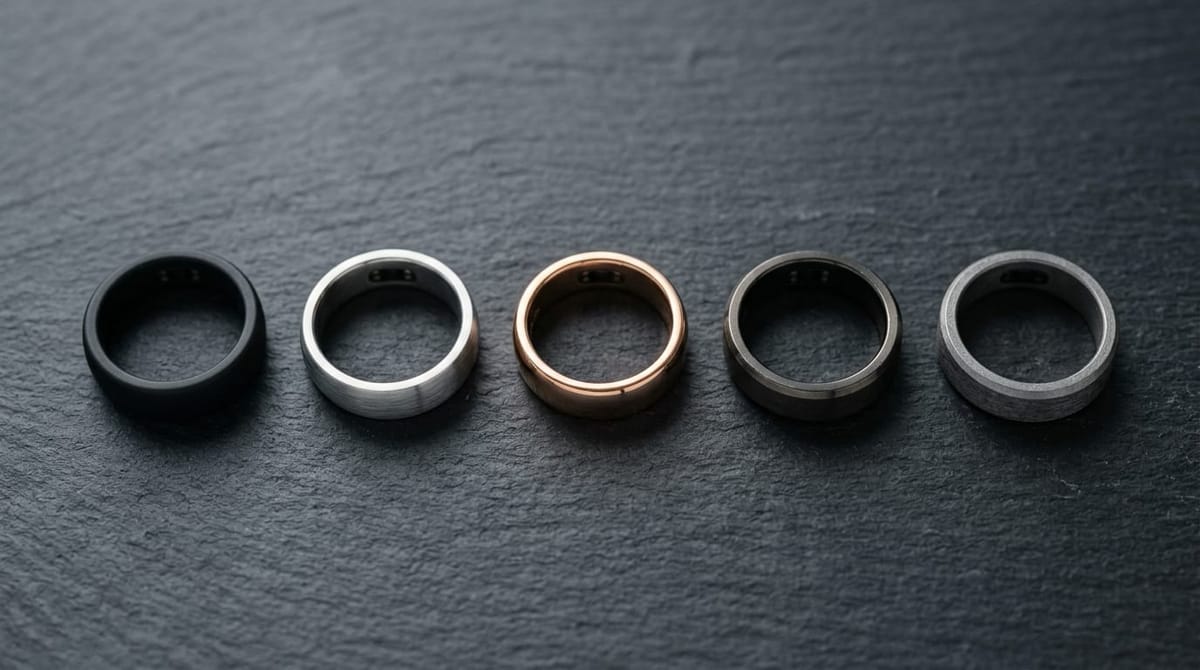
The best smart ring in 2026 is no longer the only smart ring in 2026. Five brands now ship credible products, two of them are subscription-free, and the category leader is fighting active patent litigation in the United States. This guide tiers our top picks by use case and discloses every subscription cost and legal complication up front, so you can match a ring to your priorities rather than to whichever brand's marketing reached you first.
All pricing is in pounds sterling and accurate as of June 2026. We refresh this list quarterly. For the full criteria behind these picks - battery, sensor accuracy, sizing, app ecosystem and durability - see our companion smart ring buying guide.
How we picked
This is an editorial pillar based on the published specifications of every shipping product, the aggregated review picture from owners across major UK retailers, and our individual product reviews of the three rings we cover in depth. We do not stage hands-on weeks-of-testing claims because we have not run a six-month wear-and-tear study against five rings in parallel, and pretending otherwise would be dishonest. What we have done is read every spec sheet, every credible review and every owner complaint pattern, and translated that into picks that match real use cases.
Picks are tiered by what most buyers actually optimise for: outright capability, recurring cost, upfront price, athletic data and sleep tracking. Where a ring is good but compromised, we say so under that ring's section rather than burying the trade-off in a footnote.
What do UK buyers need to know about smart-ring patent litigation?
Oura has filed patent infringement actions against multiple competitors at the US International Trade Commission, including against Ultrahuman and RingConn, alleging infringement of patents covering smart ring sensor placement and form factor. The ITC has issued findings and remedial orders in those proceedings, all of which are subject to appeal.
The practical impact for a UK buyer in 2026 is limited. ITC remedies are import bans on the US market, not the UK or EU market. Ultrahuman and RingConn continue to ship to the UK without restriction. We mention the litigation because the picture can change - if you are buying for a relative in the United States or planning a relocation, factor in the possibility that future stock and warranty support for one of these brands in the US could be affected. UK buyers can proceed with normal confidence. For the full background see our buying guide, section seven.
Why is the Oura Ring 5 the best overall pick?
The Oura Ring 5 launched on 4 June 2026 and takes over as the best smart ring overall. It keeps everything that made Oura the category benchmark - the most mature sensor stack, the best-in-class sleep staging and readiness scoring - and fixes the two things owners most wanted changed. It is about 40% smaller than the Ring 4 (roughly 2mm narrower and 30% thinner, at 2-2.69g), and battery life rises to 6-9 days from the Ring 4's 5-8.
Two new metrics headline the upgrade: Blood Pressure Signals, which surface overnight cardiovascular patterns (trend context, not a clinical cuff reading), and Nighttime Breathing, a 30-day view of sleep-related breathing. An optional charging case that holds around a month of power makes it the easiest flagship to live with on the road.
The catch is unchanged: Oura Membership is still mandatory for the full feature set at £5.99/month or £69.99/year, so budget for the subscription on top of the £399 starting price (£499 for premium finishes). If you want the best all-round smart ring and you are comfortable with a recurring fee, this is the one to buy. See our full Oura Ring 5 review.
We may earn a commission if you buy through links on this page, at no extra cost to you. It never affects our picks or rankings. Full disclosure.
Why is the Oura Ring 4 still worth buying?
With the Ring 5 now leading the range, the Oura Ring 4 has become the more affordable way into Oura's ecosystem - frequently discounted since the Ring 5 launch, and still one of the most polished rings you can buy. The sensor stack is the most mature in the category, the app is best-in-class for sleep staging and readiness scoring, and the titanium build with internal recessed sensors feels closer to jewellery than to a fitness tracker. The fourth-generation hardware brought a slimmer profile, a more comfortable inner surface and an improved heart-rate algorithm - all incremental but in the right direction.
The catch is the subscription. Oura Membership is mandatory to unlock the metrics that justify the ring's existence: Sleep Score, Readiness Score, daytime stress tracking, period prediction and the historical trend views. Without it, the ring shows basic step and heart-rate data and not much else. At £5.99 per month or £69.99 paid annually, the membership is not expensive in isolation, but it does mean the true three-year cost of ownership lands closer to £530 than £350.
Buy this ring if Oura's sleep algorithms matter to you, if you are happy paying a recurring fee for software you actually use, and if the polish of the hardware and app is worth more than the absolute lowest-cost route into the category. See our full Oura Ring 4 review for the long version.
Why is the Ultrahuman Ring Air the best subscription-free pick?
The Ultrahuman Ring Air is the strongest pick if you have a hard objection to recurring fees but still want a premium-feeling product. £299 buys the ring outright and unlocks every metric - sleep, recovery, HRV, movement, the metabolic-focused glucose-style scoring Ultrahuman built its brand on - with no monthly cost ever. The titanium build is competitive with Oura and the ring itself is lighter.
Where it falls short of Oura is in the maturity of the algorithms, particularly sleep staging. Ultrahuman's sleep insights are credible but not as nuanced, and the app's interface, while improving, still feels two iterations behind Oura's. Battery life is also slightly shorter at four to six days versus Oura's claimed eight.
The total-cost-of-ownership story is the strongest argument here. Over three years, Ultrahuman costs £299. Oura with membership costs around £530. If those two figures alone decide the question for you, this is your ring. See our full Ultrahuman Ring Air review.
Why is the Ultrahuman Ring Pro the best flagship alternative to Oura?
Ultrahuman launched the Ring Pro on 27 February 2026 as a clear flagship-tier challenger to Oura, sitting above the Ring Air in the same lineup. It is the first smart ring most reviewers consider a direct alternative to Oura rather than a budget option.
The headline upgrade is battery life. Ultrahuman claims up to 15 days per charge - more than twice the Ring Air's ~6-7 days and well clear of Oura Ring 4's ~7 days. The included charging case extends that by a further ~45 days, which makes the Pro the obvious choice for travel-heavy users who do not want to think about charging weekly.
Hardware highlights: titanium unibody, a redesigned heart-rate sensor with stronger signal quality during sleep and recovery, a dual-core processor that markedly speeds up in-app interactions, and 250 days of on-ring health history (up from 7 days on the Ring Air). The headline software feature is Jade by Ultrahuman, a real-time biointelligence layer that surfaces actionable insights and triggers events such as AFib detection without round-tripping to the app.
UK pricing is £429 (vs £329 for the Ring Air and £309 for the RingConn Gen 3). It uses no subscription - the gap to Oura's £399 hardware + £5.99/month membership widens further the longer you own the ring.
Buy the Ring Pro if you want flagship-tier features without paying Oura's subscription, you travel often enough that 15-day battery matters, and you can absorb the £90 premium over the Ring Air. Stick with the Ring Air if the battery jump from one week to two does not move you and you prefer the £90 saving.
Why is the RingConn Gen 2 the best-value pick?
The RingConn Gen 2 is the lowest entry point into a credible smart ring at £259 with no subscription. The hook is battery life: RingConn claims 10 to 12 days on a charge, comfortably the longest in the category, and owner reports broadly support that figure. The included charging case extends total wear time to roughly 150 days between mains charges, which is a quiet luxury once you have lived with it.
What you give up at £239 is some of the sensor precision and app sophistication of the £100-pricier options. RingConn's sleep and HRV data tracks the same direction as Oura and Ultrahuman in head-to-head owner comparisons, but the absolute numbers vary more night to night, and the app's interpretive layer is thinner - you get the data but less of the coaching.
Buy this ring if you want the longest-running, lowest-cost route into the category and you are comfortable doing your own interpretation of the metrics. See our full RingConn Gen 2 review.
Why is the RingConn Gen 2 Air the lightest budget pick?
If you want the no-subscription deal in the slimmest possible body, the RingConn Gen 2 Air is the one to look at. At 2.5–4 g and 2 mm thick it is among the lightest rings sold, and it streets a little below the standard Gen 2. You give up the Gen 2's sleep apnoea monitoring, two days of battery and the portable charging case, but the core sleep, heart-rate and SpO2 tracking is identical. See our full RingConn Gen 2 Air review for the detail.
Why does the RingConn Gen 3 add haptics and vascular insights?
RingConn launched the Gen 3 on 5 May 2026, the third generation of its no-subscription smart-ring line. The headline additions over the Gen 2 are two: a built-in vibration motor that delivers real-time haptic alerts directly from the ring, and a vascular-insights module that reports blood-pressure trends and pulse-wave characteristics.
The haptic alert is the bigger usability upgrade. Until the Gen 3, smart rings could log a high heart rate or an SpO2 drop but had no way to surface it without the user opening the phone app. The Gen 3 buzzes on AFib warnings, irregular pulse signals and high-stress alerts, which removes the 'noticed the alert two hours later in the app' lag that limited the value of earlier rings for active health-monitoring use cases.
The vascular-insights tab is positioned as a trend tool rather than a clinical blood-pressure cuff - it gives directional change indicators between cuffed measurements, useful for tracking morning-to-evening trends rather than for a precise mmHg reading.
Battery is 11-14 days in standard mode (vibration mode drops it to ~10), titanium construction in five finishes, sizes 6-15. Pricing starts at $349 in the US (pre-orders ran through May at $314), with UK availability via Currys and Amazon UK; no subscription required for any of the core features.
Buy the Gen 3 if you want haptic alerts (the biggest functional gap in earlier rings), the new blood-pressure-trend tab interests you and you want to avoid Oura's subscription. Stick with the Gen 2 if those two additions do not change your use case and you can find Gen 2 stock at clearance pricing.
Why is the Amazfit Helio Ring best for athletes?
The Amazfit Helio Ring has an RRP of £269 but is widely discounted to around £140 in the UK as of June 2026, which makes it the cheapest credible ring in this guide and the most athletically focused entry. It runs the same Zepp App ecosystem Amazfit uses across its watch line. The pitch is integration: if you already wear an Amazfit watch in training and want a ring to capture sleep and recovery without doubling up on wrist hardware overnight, the Helio Ring slots into the same app with no extra subscription.
The trade-off is that the Helio Ring is the youngest product in this list and its sensor accuracy reviews are mixed in independent UK reporting. Owners running it alongside chest-strap heart-rate monitors during workouts have flagged occasional spikes that don't track the strap data, which is a real issue if you rely on the ring for exercise heart-rate. As a passive recovery and sleep companion to a more accurate workout device, however, it does the job at the lowest price in the segment.
The reason it earns the athlete tier is the Zepp integration. If you do not already use Amazfit kit, prefer the Ultrahuman Ring Air for athletic use - its recovery scoring is better tuned and standalone. One forward-looking caveat: Amazfit has confirmed a Helio Ring 2 for the second half of 2026, so if you are not in a hurry it may be worth waiting to see how the successor is priced and specified before buying the original.
Why does the Oura Ring 5 win for sleep tracking?
Sleep tracking is the original use case for smart rings and it remains the area where the gap between options is largest. Oura's sleep staging - the breakdown of light, deep, REM and awake periods - has been refined over a decade across five hardware generations and is the most credible in the category by a meaningful margin. Owners switching from Oura to other rings consistently describe the new ring's sleep data as plausibly correct but less granular.
If sleep is the single reason you are buying a smart ring - to track shift patterns, recover from poor weeks, evaluate the effect of lifestyle changes - the £5.99 monthly membership is easier to justify because the sleep view is exactly what the subscription unlocks. For deeper context on what the metrics actually mean, see our explainer on smart ring health metrics.
Is the Samsung Galaxy Ring worth considering?
The Samsung Galaxy Ring sits at around £399 and is the strongest pick for one specific buyer: a Samsung phone owner already invested in Samsung Health. It plugs into the same ecosystem that powers Galaxy Watch, syncs cleanly with the phone, and currently surfaces its full feature set through the included Samsung Health platform without a separate recurring fee.
For anyone not already in the Samsung ecosystem, it is hard to recommend at this price. The hardware is competent and the app integration is the smoothest of any ring tested alongside its parent phone, but the absolute quality of the sleep and recovery insights does not yet match Oura, and the price sits above Ultrahuman with no real edge for non-Samsung users.
One thing worth watching: Samsung has not committed publicly to keeping the full Samsung Health feature set free indefinitely. If you buy this ring, treat it as you would any platform-tied wearable - your full experience depends on a manufacturer's ongoing software decisions.
How do the rings compare at a glance?
Top smart rings 2026 - at a glance
- Best overall - Oura Ring 5
- from £399 + £5.99/mo membership; ~40% smaller than Ring 4; 6-9 day battery
- Best budget route into Oura - Oura Ring 4
- £349 (often discounted) + £5.99/mo membership; titanium; ~8 day battery
- Best flagship, no subscription - Ultrahuman Ring Pro
- £419; titanium; up to 15-day battery; no fees
- Best subscription-free - Ultrahuman Ring Air
- £299; titanium; ~4–6 day battery; no recurring fees
- Best haptic alerts - RingConn Gen 3
- ~£349; 11-14 day battery; haptic AFib/stress alerts; no fees
- Best value - RingConn Gen 2
- £239; titanium; ~10–12 day battery; case extends to ~150 days; no fees
- Best for athletes - Amazfit Helio Ring
- RRP £269, ~£140 street; Zepp app; no fees; best paired with an Amazfit watch
- Best for sleep - Oura Ring 4
- Most mature sleep-staging algorithm in the category
- Honourable mention - Samsung Galaxy Ring
- £399; best for Samsung phone owners on Samsung Health
What about the Circular Ring 2?
The Circular Ring 2 is worth knowing about but hard to recommend over the picks above. It is available now from around £280 with no subscription, and on paper it is ambitious: ECG with FDA-cleared AFib detection, an eight-day battery, and planned blood-glucose and blood-pressure features. The hardware itself is genuinely good.
The problem is execution. Independent reviewers consistently praise the ring but find the companion app underbaked, with its AI-driven insights feeling half-finished next to Oura's polished analysis or RingConn's clean data presentation. If you want a no-subscription ring today, the RingConn Gen 2 or Gen 3 are the safer buys; revisit Circular once its software catches up to its hardware.
More smart ring guides

Best Smart Ring for Hiking and Altitude UK 2026
Best Smart Ring for Small Fingers UK 2026
Smart Ring vs Fitness Tracker Band UK 2026
Smart Ring Without a Subscription
RingConn Gen 2 Air Review

Noise Luna Ring Review

Best Smart Ring for Golf UK 2026

Best Smart Ring for Students UK 2026

Best Smart Ring for Biohackers UK 2026
Smart Ring + Komoot: Does It Work?

Smart Ring + Zwift: What Works

Smart Ring for Fibromyalgia UK 2026

Can a Smart Ring Help With IBS and Gut Health?

Do Smart Rings Get You Health Insurance Discounts?

Smart Ring Myths Debunked UK 2026
Frequently asked questions
What is the best smart ring overall in 2026?
Are subscription-free smart rings any good?
How long do smart rings last on a charge?
Does the Oura-Ultrahuman patent dispute affect UK buyers?
Which smart ring is best for sleep tracking specifically?
Are smart rings actually worth it?
Not sure which tier fits you?
Our buying guide walks through the seven factors that actually decide whether a smart ring is worth £399+ - subscription tolerance, fit, sensor accuracy, app ecosystem, durability and more.