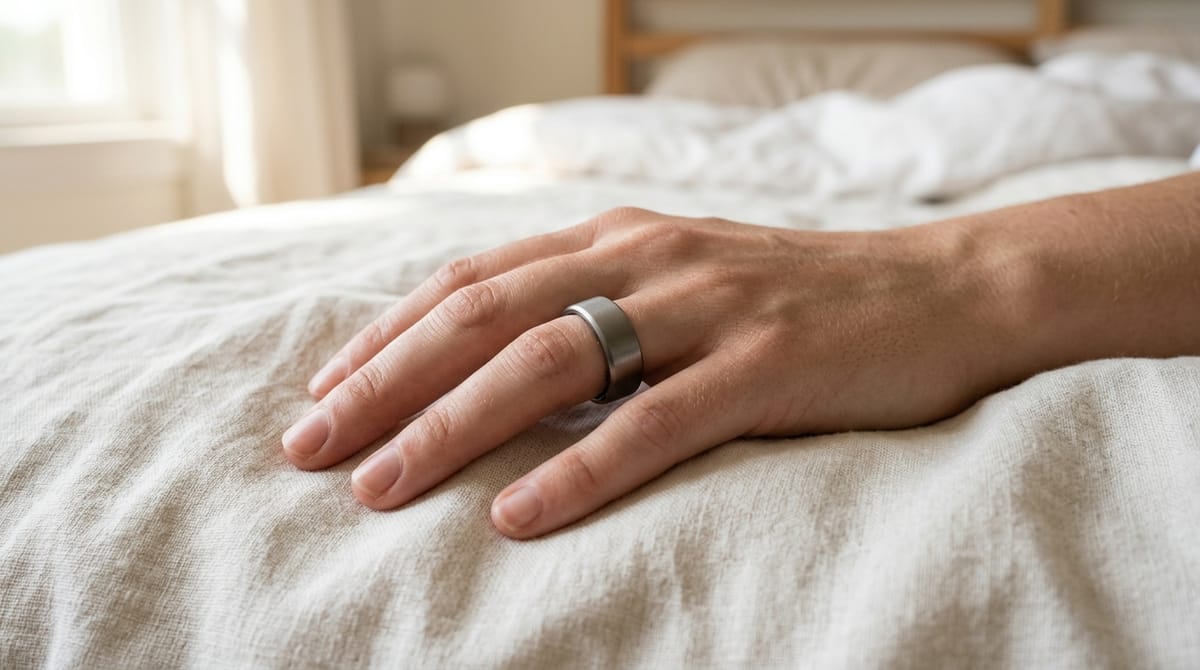
COLMI R02 Smart Ring Review (UK 2026): Honest Budget Pick
The COLMI R02 (and broader COLMI ring family) is the right pick for one specific use case: total beginners who want to test the smart-ring form factor before committing to a £329-£399 premium ring. Treat it as a step + heart-rate tracker, not as a sleep + HRV diagnostic. Sub-£60 pricing comes with sub-£60 build quality (6-12 month service life), sub-£60 app polish, and sub-£60 sensor accuracy. Worth £45 to confirm interest; not worth replacing your Oura or Ultrahuman if you already own one.
Strengths
- £30-£60 - lowest barrier to entry in smart ring category
- Functional step counter + resting heart rate
- No subscription
Watch outs
- Sleep + HRV are directional only - not for training decisions
- 6-12 month typical service life with daily wear
- App UX meaningfully rougher than Oura/Ultrahuman/Apple
We may earn a commission if you buy through this link - it never changes the price you pay or our editorial verdict.
As an Amazon Associate I earn from qualifying purchases.
The COLMI smart ring family is a stress-test for the smart-ring category - it's what happens when you take the form factor and squeeze the manufacturing cost to a minimum viable price. £30-£60 buys you a working device that produces step counts and a heart rate, with sleep + HRV outputs that exist on the screen but shouldn't drive any real decisions. This review covers what the COLMI R02 actually does, who it serves, and where its limitations land.
What you actually get for £45
The COLMI R02 measures step count via accelerometer and resting + active heart rate via optical PPG sensor. These two outputs are reasonably accurate in owner-published comparisons (step count typically within 5% of phone GPS; resting heart rate within 3-5 BPM of chest-strap reference). For a £45 device, this is genuine functionality.
The challenges are everywhere else:
Sleep tracking is directional only. The R02 reports total sleep time and a simplistic stage breakdown (REM/deep/light). Compared to polysomnogram (the gold-standard sleep study), the R02's stage breakdown is around 55-60% epoch-level agreement - meaningfully worse than Oura Ring 4 (~73%) or Apple Watch (~70%). Total sleep time is usable; the stage breakdown should not drive any decisions.
HRV reads are noisy. The PPG sensor doesn't have the multi-LED setup the premium rings use. Per published comparisons, COLMI HRV correlation against a chest-strap reference is around 0.50-0.60 (vs Oura's 0.85+). Single-night HRV reads should be ignored; multi-week trends might be loosely useful but with substantial noise.
No temperature sensor. The R02 doesn't include a skin-temperature sensor at all. This rules out cycle tracking, fever detection, and any temperature-based recovery insight. Premium rings (Oura 4, Ultrahuman Ring Air) include continuous overnight temperature monitoring which is genuinely useful; the COLMI doesn't have this hardware.
App UX is rough. Compared to Oura's polished consumer-wellness app or Apple's tightly-integrated Health app, COLMI's app (COLMI Wear, or various generic Bluetooth health apps that pair with it) is functional but unrefined. Settings are buried in menus, charts are basic, integrations with Apple Health and Google Health Connect are partial.
Who the COLMI R02 is for
Total beginners testing the form factor. If you've never worn a smart ring and you're unsure whether you'd actually use one consistently, £45 + Amazon UK's return policy gives you a low-risk test. After 2-3 months of daily wear you'll know whether you should commit to a £329 premium ring or whether the form factor doesn't suit you.
Gift buyers wanting 'smart ring' without the premium-tier price. The R02 makes a reasonable gift for someone curious about wearables - the recipient gets something that works as a step + heart-rate tracker without you spending £329 on something they might not use.
Backup or loaner. Premium-ring owners sometimes keep a budget ring as a backup for the days when their primary is charging or for handing to a guest who wants to try the form factor.
Children or teens who want to try wearable tech. The R02's lower price point reduces the cost of a child outgrowing or losing it. The data quality limits don't matter as much at the casual-curiosity level.
Who should look elsewhere
Anyone wanting reliable sleep-stage data. The R02's 55-60% PSG agreement is meaningfully worse than the £329 Ultrahuman Ring Air or the £259 RingConn Gen 2 in the no-subscription tier. If sleep quality is your primary use case, the premium tier matters.
Anyone making training decisions on HRV. COLMI HRV is too noisy for daily training-readiness decisions. Polar H10 chest straps, Whoop bands, or Oura/Ultrahuman rings are appropriate for HRV-led training; the COLMI is not.
Anyone tracking menstrual cycles. No temperature sensor = no cycle tracking. See our cycle tracking guide for the appropriate options.
Anyone planning to wear it 2+ years. The R02's 6-12 month service life makes total-cost-of-ownership comparable to upgrading to a more durable Amazfit Helio Ring (£149.90) every 3-4 years.
How it compares to the under-£150 tier
| COLMI R02 | Amazfit Helio Ring | RingConn Air | |
|---|---|---|---|
| Tier | Entry / try-before-commit | Best sub-£150 | Budget no-sub |
| Build | Plastic with metal-effect coating | Titanium-coated | Titanium body |
| Sensors | PPG + accelerometer (no temp) | PPG + accelerometer (no temp) | PPG + accelerometer (no temp) |
| Sleep-stage accuracy | ~55-60% PSG agreement | ~63% PSG agreement | Acceptable |
| HRV accuracy | ~0.50-0.60 vs chest strap | ~0.60-0.70 vs chest strap | ~0.55-0.65 vs chest strap |
| App polish | Rough | Mature (Zepp ecosystem) | Functional |
| Service life | 6-12 months daily wear | 2-3 years | 2-3 years |
| Best for | Curious testers, gift buyers, backups | Subscription-averse buyers wanting good data | Battery-life-led buyers |
Frequently asked questions
Is a £45 smart ring worth buying?
How accurate is COLMI sleep tracking?
How long does the COLMI R02 last?
Can I use the COLMI R02 for swimming?
Does COLMI have an iOS app or only Android?
Best Smart Ring Under £150
Smart Ring Without a Subscription
Best Smart Ring UK 2026