Smart Ring Sleep Stage Accuracy: How Reliable Is It?
How accurate are smart-ring sleep stages compared to a sleep-lab PSG? Honest answer with peer-reviewed evidence and what each ring actually measures.
What does 'sleep stage accuracy' actually mean?
The gold standard for measuring sleep is a polysomnogram (a clinical overnight study that combines EEG brain-wave recording with eye movement, muscle tone and respiratory sensors). PSG scores sleep in 30-second windows and assigns each window to one of four stages: wake, light (combining N1 and N2), deep (N3 or slow-wave sleep) and REM. Any consumer device that claims to report sleep stages is making an estimate of what the PSG would have scored - using a far smaller set of sensors than the lab does.
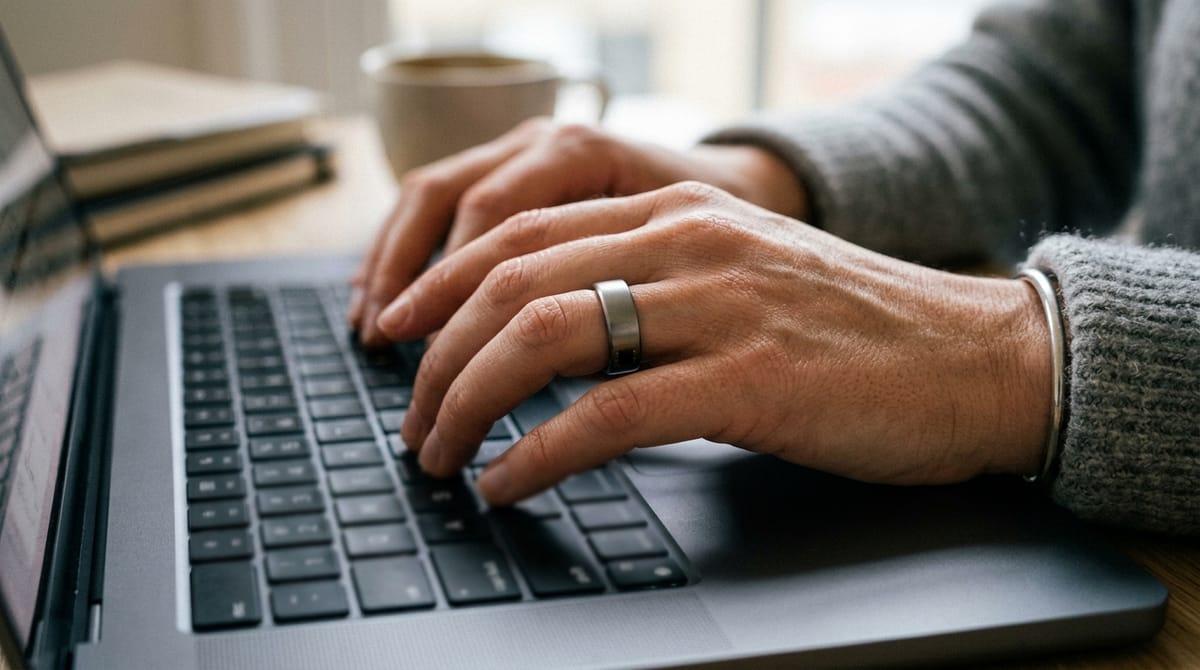
Smart rings sit at the wrist-and-finger end of the consumer-wearables spectrum. They do not measure brain waves. Instead they use a finger-worn photoplethysmography sensor (an optical heart-rate and heart-rate-variability reader, often abbreviated PPG), a skin-temperature sensor and a 3-axis accelerometer for movement. The ring's app runs a proprietary model that takes those inputs and outputs a sleep-stage hypnogram. The honest question is how often that hypnogram agrees with the PSG it is trying to predict.
What does independent testing show?
The most informative public data on smart-ring sleep accuracy comes from independent reviewer Quantified Scientist (a former sleep researcher who runs head-to-head tests of consumer wearables against a Zmachine Insight+ home PSG). His published comparisons of Oura Ring 3, Oura Ring 4, Ultrahuman Ring Air, RingConn Gen 2, Amazfit Helio and Samsung Galaxy Ring put epoch-by-epoch sleep/wake agreement in the 85-90 percent range and four-stage agreement in the 65-75 percent range for the leading models. The cheaper subscription-free entries cluster slightly lower on stage agreement (closer to 60-70 percent) but match the leaders on total-sleep-time accuracy.
Peer-reviewed sleep-lab work tells a consistent story. A widely cited 2023 evaluation of consumer wearables against PSG in Sensors (PMC10131554) found that finger-worn PPG-and-accelerometer devices broadly matched the lab on total sleep time and wake detection, but systematically over-estimated REM and under-estimated wake-after-sleep-onset. An earlier validation of the Oura Ring (2nd generation) published in Behavioral Sleep Medicine (PMC5811844) reported 96 percent agreement on sleep/wake but only around 65 percent on stage classification. The pattern is consistent: total sleep time is the metric you can trust; stage breakdown is directional, not diagnostic.
Where is smart-ring sleep tracking most accurate?
Some sleep metrics are far more reliable than others. The list below reflects what independent tests and peer-reviewed validations agree on.
Total sleep time - typically within 10-15 minutes of PSG across leading rings. The single metric most worth trusting.
Sleep/wake classification - 85-90 percent epoch-level agreement on leading rings. Useful for tracking sleep efficiency trends.
Resting heart rate while asleep - PPG measures this directly, so the number is close to ECG.
Heart-rate variability trend - directionally reliable as a recovery proxy when the same ring is worn consistently.
Skin-temperature deviation from your baseline - useful for cycle and illness early-signals; not a clinical thermometer.
Where does smart-ring sleep tracking fall short?
Deep sleep duration - typically over-estimated. Treat your nightly deep-sleep minutes as a relative number to compare against your own baseline, not as an absolute one to compare against a friend.
REM sleep duration - over-estimated on most rings, with REM commonly classified during light-sleep windows. The trend is meaningful; the headline number is not.
Sleep-onset latency - devices tend to under-estimate the time it takes you to fall asleep, because brief micro-awakenings show up as movement-free epochs the ring labels as light sleep.
Naps under 20 minutes - frequently missed entirely. The algorithms need a sustained low-movement window to classify a sleep event.
Sleep apnoea or arousal events - not what these devices are built for. A PPG ring cannot detect the airflow drop or oxygen desaturation pattern that defines an apnoea. If you suspect a sleep disorder, the ring is not a diagnostic tool.
Do more expensive rings track sleep more accurately?
Across recent independent testing the gap between leading rings is smaller than the price gap suggests. Oura Ring 4 has historically held the narrowest edge on stage-classification accuracy, with Ultrahuman Ring Air close behind on sleep/wake and stage. RingConn Gen 2 trails the leaders on stage breakdown but matches them on total-sleep-time and resting-heart-rate measurement at roughly two-thirds of the first-year cost. Amazfit Helio sits a step further behind on stage agreement and a step ahead on total cost (no subscription, around £200 hardware). The honest summary: for total sleep time the cheapest ring in our reviews will do; for stage breakdown the price ladder buys you better, but only by single-digit percentage points.
Our individual reviews dig into the published comparisons for each model - see the Oura Ring 4 review, Ultrahuman Ring Air review, RingConn Gen 2 review and Amazfit Helio Ring review for the per-ring detail. The smart-ring health metrics explainer covers the underlying sensors in more depth.
How should you read your sleep data?
Treat the nightly stage breakdown the same way you would treat a step count: directionally useful, not clinically precise. A few practical rules pull more value out of the data than any single metric headline.
Compare to your own baseline, not a friend's
Two weeks of nightly data gives you a personal baseline for total sleep time, deep-sleep minutes and HRV. After that, deviations from your baseline (a 30-percent HRV drop, a 90-minute sleep deficit) are the signal - not the absolute number compared to anyone else.
Watch the trend, not single nights
One bad night of measured deep sleep is noise. A two-week downward trend in deep-sleep minutes against your baseline is the kind of pattern worth acting on - usually by adjusting bedtime, caffeine timing or alcohol intake.
Believe the total-sleep-time number
If your ring says you slept six hours fifteen minutes, that is probably within ten to fifteen minutes of the truth. Use this number to set realistic sleep targets and to spot the weeknight pattern that is keeping you tired.
Treat stage minutes as relative
Tonight had more deep sleep than last night is a fair claim. Tonight I got the recommended 90 minutes of deep sleep is not - the recommended number is itself a population average, and your ring's measurement of stage minutes carries a margin of several percent.
If you suspect a real sleep disorder, see a doctor
Apnoea, restless legs, parasomnia and circadian rhythm disorders cannot be diagnosed from a wrist or finger device. Use the ring data as input to a conversation, not as evidence against the need for clinical sleep medicine.
Frequently asked questions
Is smart-ring sleep tracking as accurate as a sleep lab?
Which smart ring is most accurate for sleep tracking?
Do smart rings over-estimate or under-estimate deep sleep?
Can a smart ring detect sleep apnoea?
Why does my smart ring sometimes miss a nap?
Smart Ring Health Metrics Explained
HRV Explained: What Your Smart Ring HRV Number Really Means

Best Smart Ring for Athletes