Samsung Galaxy Ring Review (2026): No Fees, One Catch
The Samsung Galaxy Ring is the strongest no-subscription smart ring on the UK market in 2026 if - and only if - you already own a Galaxy phone. The £399 RRP buys a titanium ring with credible sleep and HRV tracking, deep Samsung Health integration, and lifetime feature access. Drop the Galaxy phone requirement and the value proposition weakens significantly: there is no fully-supported iOS app, and the most interesting AI insights need a Galaxy device. Score: 4.0 / 5.
Strengths
- No subscription - every feature works for the lifetime of the device, a refreshing change from the category leader
- Concave outer profile in titanium resists everyday scuffs visibly better than flat-faced rivals
- Wireless charging case included in the box - a category first that genuinely helps on travel
Watch outs
- Android-only in practice - there is no fully-supported iOS app, ruling out roughly half the UK smartphone market
- The most useful AI insights require a Galaxy phone running One UI 6.1+ - a non-Samsung Android pairing loses much of the value
- Sensor count is conservative - no SpO2, no ECG, no always-on skin-temperature stream, so sleep-stage detail is less granular than Oura's
- Material Titanium
- Finishes Titanium Black, Titanium Silver, Titanium Gold
- Sizes 9 (US 5 through US 13)
- Weight 2.3–3.0g depending on size
- Sensors PPG (HR / HRV), skin temperature, 3-axis accelerometer
- Water resistance 10 ATM + IP68
We may earn a commission if you buy through this link - it never changes the price you pay or our editorial verdict.
As an Amazon Associate I earn from qualifying purchases.
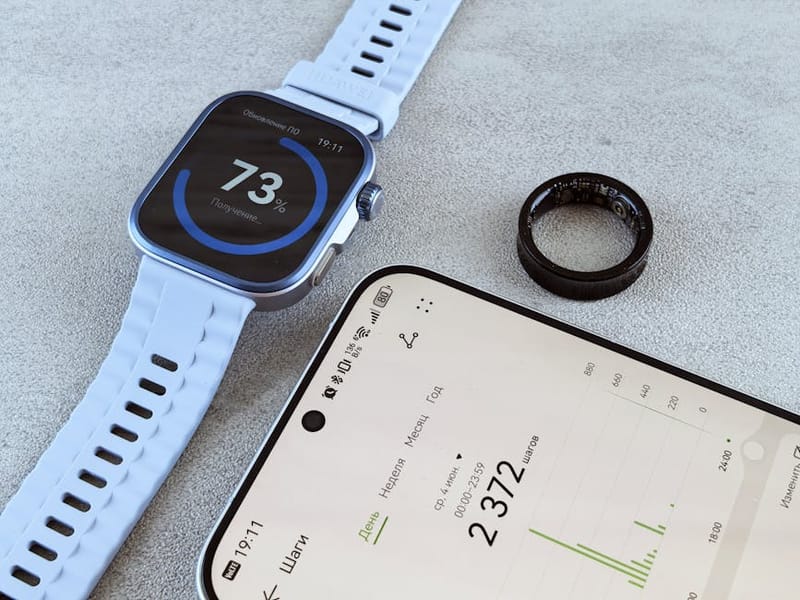
The Samsung Galaxy Ring is Samsung's first wearable in ring form - a £399 titanium ring with no subscription, deep Samsung Health integration, and a wireless charging case in the box. It is the most credible no-subscription rival to the Oura Ring 4 in 2026, with one major caveat: it is genuinely an Android product, and the most useful features require a Galaxy phone specifically. This Samsung Galaxy Ring review walks through what you get for £399, the iOS gap that excludes half the smartphone market, where the data sits versus the category leader, and who should actually buy it.
What do you get for £399?
The Samsung Galaxy Ring launched in the UK in July 2024 with a £399 RRP and has held that price through 2026 outside of occasional sale periods. The box contains the ring itself, a small wireless charging case (closer in form factor to AirPods than to a traditional charging puck), a USB-C charging cable, and documentation. Samsung ships a free sizing kit on request before purchase, which is essential - ring sizing is unforgiving and a one-size-up or one-size-down purchase will not be comfortable for 24/7 wear.
The ring itself is titanium, available in Titanium Black, Titanium Silver, or Titanium Gold. Sizes run from US 5 through US 13, giving Samsung the widest size range in the category. Weight ranges from roughly 2.3g at size 5 to about 3.0g at size 13 - light enough that most wearers stop noticing it within a day.
The concave outer profile is the standout physical design choice. Where the Oura Ring 4 has a flat outer face that scuffs visibly within a few months of manual work, the Galaxy Ring's curved outer surface resists everyday contact better. It's a small thing that matters more than you'd expect if you use your hands for work, lift weights, or routinely catch your ring on cookware and door handles.
What's the iOS problem with the Galaxy Ring?
Before going further, the elephant in the room: the Samsung Galaxy Ring does not have a fully-supported iOS experience. Samsung Health technically has an iOS app, but the Galaxy Ring is not a documented supported device on iOS, and the AI features that Samsung markets most heavily - the Energy Score, the AGEs Index, integrated sleep coaching - require a Galaxy phone running One UI 6.1 or later.
In practical terms, if you own an iPhone you should not buy the Galaxy Ring. Even informal pairing reports from the iOS community are inconsistent - basic step and heart-rate sync works for some users, advanced metrics for none, and Samsung offers no support pathway for problems. The Oura Ring 4 is the obvious pick for iPhone owners; it has first-class iOS support and arguably the best iOS smart-ring app on the market.
Even within Android, the Galaxy Ring is at its best paired with a Galaxy phone. Samsung Health runs on most Android devices, but a OnePlus, Pixel, or Xiaomi phone will not unlock the Galaxy AI insights. The ring still works as a daily-readiness tracker on non-Samsung Android, but you are paying £399 for a smaller subset of features than the marketing suggests.
How is sleep, HRV and overall data quality?
The Galaxy Ring's sensor stack is conservative compared to the Oura: PPG for heart rate and HRV, skin temperature, a 3-axis accelerometer for movement and sleep posture. There is no SpO2, no ECG, and no continuous skin-temperature stream - temperature is sampled at intervals rather than continuously.
The sleep data is good but not category-leading. Samsung's sleep-staging algorithm inherits maturity from the Galaxy Watch product line, which has been refining its sleep algorithm since the Galaxy Watch Active 2 era. Independent reviewers running side-by-side comparisons with the Oura Ring 4 consistently report that the two devices reach broadly similar sleep-time and sleep-efficiency totals, but the Oura's sleep-stage breakdown (light / deep / REM / awake) is more granular and aligns more closely with polysomnography in the small number of published independent tests.
Heart-rate variability tracking on the Galaxy Ring is sampled in discrete windows during sleep rather than running continuously across the day. For users who treat HRV as a daily readiness signal - "is my body recovered enough to train hard today?" - that's perfectly adequate. For users who want continuous HRV trends across the working day for stress monitoring, the Oura's approach is more useful.
The Energy Score is Samsung's daily readiness metric, comparable to Oura's Readiness Score or Whoop's Recovery Score. It blends sleep quality, HRV, resting heart rate, and recent activity into a single 0–100 figure. Independent reviewers have noted that the score is conservative - it tends not to swing wildly day-to-day, which makes the trend more useful than the daily number.
What's the battery life and charging experience?
Samsung advertises up to 7 days of battery life on the Galaxy Ring. Independent reviewers consistently land in the 5–7 day range depending on ring size (smaller sizes carry physically smaller cells), how often live heart-rate readings are triggered, and whether continuous heart-rate monitoring is enabled. Larger sizes (11–13) reliably hit the upper end of that range; sizes 5 and 6 reportedly sit closer to 5 days.
The wireless charging case is the standout feature. It holds extra capacity - you can leave the case unplugged for several days and still get multiple ring top-ups from it. For travel, that's transformative compared to the standard category approach of a fixed-position puck that needs mains power. The case takes the ring from flat to full in roughly 80 minutes, with quick-charge to about 50% in under half that.
How are health, cycle, and pregnancy tracking?
Samsung's women's-health implementation in Samsung Health is more capable than it was a year ago but still trails Oura's. Cycle prediction works, fertile-window estimates exist, and the skin-temperature data is folded into the predictions. Pregnancy tracking is supported but is more comparable to what you'd get from a dedicated app like Flo than to Oura's deep cycle insights.
The AGEs Index is the most distinctive health metric Samsung has added. AGEs (Advanced Glycation End-products) are a marker associated with metabolic health and vascular ageing; Samsung uses a finger-skin measurement to produce a single index score. It's an interesting and uncommon metric in the smart-ring category, though the clinical literature on at-home AGEs measurement is still evolving and the practical day-to-day actionability of the number is limited.
Who should buy the Samsung Galaxy Ring?
Buy the Galaxy Ring if: you already own a recent Galaxy phone (S22 or later, Z Flip4 or later, A series running One UI 6.1+), you dislike subscriptions on principle, you already use Samsung Health for other tracking, the AGEs Index appeals to you, or you simply want a clean total-cost-of-ownership story.
Don't buy it if: you use an iPhone (look at the Oura Ring 4 instead), you use a non-Samsung Android (the Ultrahuman Ring Air or RingConn Gen 2 are stronger picks for cross-platform Android), or your headline reason for buying a ring is the deepest possible sleep-stage and HRV analysis (Oura keeps the lead there).
The straight head-to-head against the category leader is worth reading in full - see our Oura Ring 4 vs Samsung Galaxy Ring comparison for the full ecosystem-versus-subscription breakdown.
Frequently asked questions
Does the Samsung Galaxy Ring work with an iPhone?
Does the Galaxy Ring require a subscription?
How long does the Galaxy Ring's battery last?
Is the Samsung Galaxy Ring waterproof?
Can I use the Galaxy Ring with a non-Samsung Android phone?
How does the Samsung Galaxy Ring compare to the Oura Ring 4?
Check current UK pricing
UK pricing varies by retailer and is often discounted during Samsung sale periods, especially bundled with a Galaxy phone purchase.