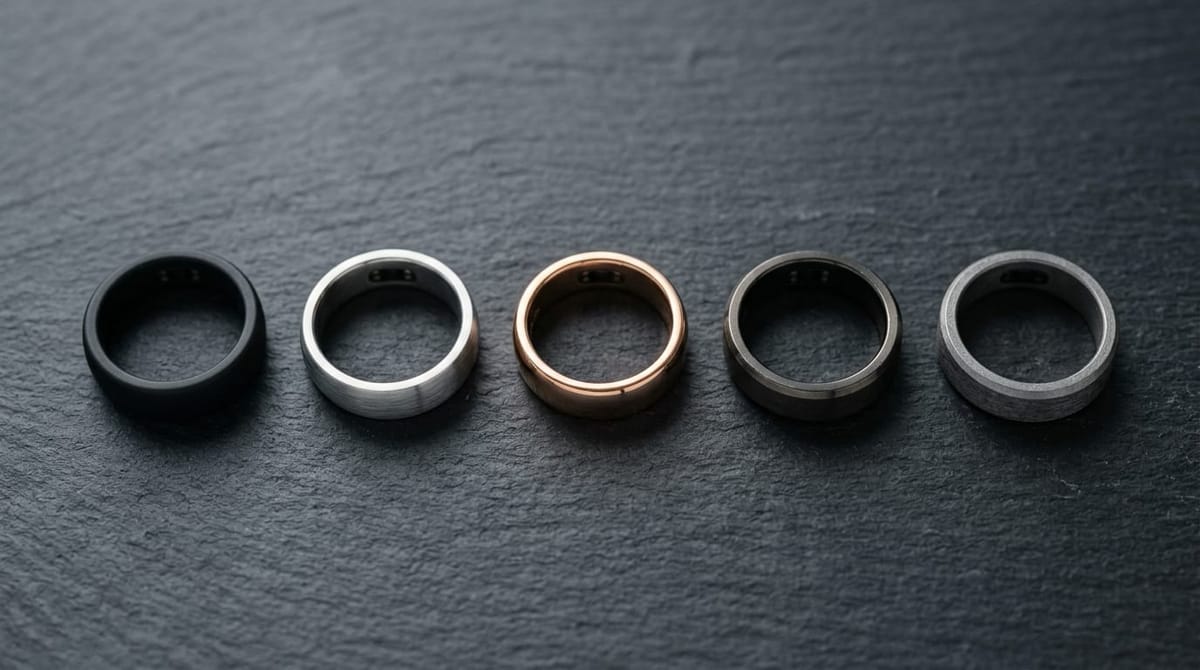
Smart Ring Battery Life Ranked: 2026 Real-World Days
Real-world battery life for the five smart rings worth buying in 2026, ranked. Measured ranges from independent testing, not manufacturer claims.
How long does a smart ring battery actually last?
The table below is our running 2026 battery-life ranking, refreshed quarterly. The figures are the realistic range under typical sensor use (continuous heart rate, sleep tracking, automatic SpO2 spot-checks where the ring supports them) - not the marketing claim on the box. Manufacturer numbers tend to assume best-case settings and a fully broken-in battery; real-world numbers fall 1-2 days below them on every ring we have data for.
| RingConn Gen 2 | Samsung Galaxy Ring | Amazfit Helio Ring | Ultrahuman Ring Air | Oura Ring 4 | |
|---|---|---|---|---|---|
| Real-world battery | 10-12 days | 5-7 days | 4-7 days | 4-6 days | 4-5 days |
| Manufacturer claim | 12 days | 7 days | Up to 7 days | Up to 6 days | Up to 8 days |
| Subscription | None | None | None | None | £5.99/mo for full features |
| Charging time | ~90 mins via charging case | ~80 mins on supplied dock | ~120 mins on supplied dock | ~100 mins on supplied dock | ~80 mins on supplied dock |
Why does RingConn Gen 2 last so much longer?
The RingConn Gen 2 has roughly the same battery capacity as the other rings in this table - a few dozen mAh in the ring itself. The reason it lasts twice as long comes down to two trade-offs RingConn makes:
Less frequent sensor polling. The Gen 2 samples heart rate and motion at lower frequencies than Oura Ring 4 or Ultrahuman Ring Air, particularly outside of sleep windows. This costs some accuracy on continuous resting-heart-rate trends; it buys a lot of battery.
Portable charging case. The Gen 2 ships with an AirPods-style case that holds about a month's worth of ring charges. The real-world consequence is that even on a 12-day cycle, you rarely think about plugging it in - the ring drops into the case overnight when it does need a top-up, and the case lives in your bag charged from a phone cable. None of the other rings ship with anything similar.
Tungsten-carbide shell with less internal cushioning. The Gen 2 dedicates more internal volume to the battery cell than to silicone padding around the sensors. Wearers report the shell feels slightly stiffer than Oura's titanium; that volume is what the battery is sitting in.
Does the £349 Oura Ring 4 really only last 4-5 days?
Yes, in normal use. Oura advertises up to 8 days; independent reviewers consistently see 4-7 days, and the lower end of that range is closer to the typical experience because Oura's continuous-heart-rate and temperature sampling rates are among the highest in the category. The trade-off is reflected in the data quality - Oura's sleep-stage agreement with polysomnogram is the strongest of any consumer smart ring in published comparisons. Higher sampling rates cost battery; that is the bargain you accept by buying Oura.
If you find yourself charging the ring every 3-4 days because the battery dips and you sleep without it on the off-charge day, the practical fix is a daily 30-minute charge while you shower. The dock charges fast enough that you can keep the ring on a stable charge cycle indefinitely, at the cost of slightly more cognitive overhead than the longer-lasting rings demand.
How fast does each ring charge?
Charging speeds across the five rings cluster more tightly than battery life. Oura Ring 4 and Samsung Galaxy Ring both fully charge in roughly 80 minutes from empty; Ultrahuman Ring Air takes 100 minutes; Amazfit Helio is closer to 120 minutes; RingConn Gen 2 charges in 90 minutes via its case. None of them support fast-charging in the smartphone sense - the trade-off for a watch-charger-style coil that fits inside a 2-3 gram device is that the charge curve is slow and flat.
Practically, the ring goes on the dock when you shower or brush your teeth. Twenty minutes on the dock typically restores 25-30 percent of capacity - enough to bridge a missed night of charging without breaking the data cycle.
Does battery life degrade after 12+ months?
Yes, like every lithium-ion device. The honest evidence-base here is thinner than the launch-window battery numbers because most independent reviewers do not retest rings at the 12-month mark - the testing cycle has not yet established a robust dataset. Anecdotal patterns from long-term Oura Ring 3 owners (the previous generation, now 3+ years in market) suggest battery capacity drops 10-20 percent over the first year of daily wear, then stabilises. That translates to a 4-5 day Oura Ring 4 dropping to 3-4 days after a year.
Oura, Ultrahuman and Samsung all offer paid battery-replacement programmes (between £40 and £80 depending on the ring); RingConn and Amazfit do not. If long-term battery longevity is a buying factor, the longer-lasting RingConn Gen 2 also has the smaller proportional drop in years 2 and 3 - going from 12 days to 9-10 days is less disruptive than going from 5 days to 3-4 days. We will refresh this section with measured year-2 numbers as the data lands.
Which ring should you buy on battery life alone?
If battery life is the decision driver, the RingConn Gen 2 wins outright - 10-12 days on the ring plus a month-worth of charging-case capacity makes plug-in a near-non-event. The trade-off is slightly less sophisticated sleep-stage and HRV data than Oura. Our RingConn Gen 2 review covers the full set of trade-offs.
If battery life matters but accuracy matters more, the Ultrahuman Ring Air is the better pick - 4-6 days is still solid, and the sleep + recovery data is much closer to Oura's quality. See our Ultrahuman Ring Air review.
If you can pair the ring with a daily charging routine, Oura Ring 4 is still the strongest data-quality pick - the 4-5 day battery is a real constraint, but the data sophistication justifies the trade-off for many users. See our Oura Ring 4 review.
Frequently asked questions
Which smart ring has the longest battery life?
Is the Oura Ring 4 battery really only 4-5 days?
How long does it take to charge a smart ring?
Does smart ring battery life get worse over time?
Does using SpO2 or AFib monitoring reduce battery life?
Smart Ring Buying Guide: What Actually Matters
Smart Ring Sleep Stage Accuracy: How Reliable Is It?
Smart Ring Without a Subscription: 4 Worth Buying